
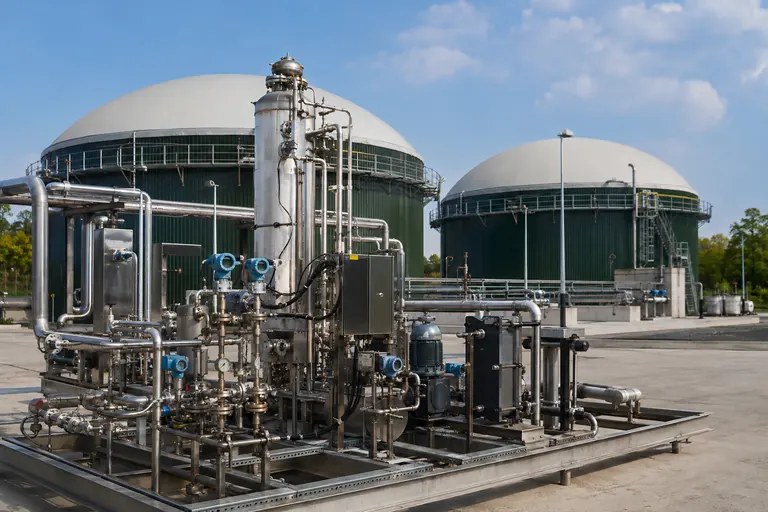
The engineering context
What determines the right system
Digester mixing aims to distribute feed and heat, maintain contact within the slurry and manage floating or settling material. The appropriate arrangement depends on geometry, working levels, fibre, grit and rheology. Neither a standard mixer count nor total installed motor power demonstrates that the required circulation will occur.
Mechanical agitation, pumped circulation and any other proposed mixing method should be evaluated against their actual duties. A hybrid arrangement is justified by the process and maintenance needs of the plant, not by the label. Each added system also adds power demand, equipment interfaces and maintenance requirements.
Specify the mixing duty before selecting the motor
| Design input | Why it changes the duty | Evidence to review |
|---|---|---|
| Slurry properties | Viscosity and fibre affect flow, torque and blockage risk | Representative sampling and rheology where needed |
| Tank geometry | Diameter, liquid depth and internals change circulation paths | Working-level drawing and arrangement study |
| Floating and settled layers | Surface crust and sediment are different operating problems | Feed preparation, observed build-up and inspection records |
| Maintenance method | A submerged component may require special removal arrangements | Isolation, lifting and replacement access |
| Verification | Power draw alone does not show whole-tank mixing | Agreed observations, measurements and CFD where justified |
Altpreneur scope
From specification to commissioning
Duty assessment
Review working volume, feed rheology, fibres, grit, heat distribution and the likely formation of floating or settled layers.
Mechanical configuration
Evaluate mounting positions, propellers or impellers, drive duties, materials and safe replacement access with the equipment supplier.
Circulation interfaces
Where included by the approved design, examine pumps, nozzles, valves and blockage management. Recirculation is a project-specific choice.
Verification
Agree commissioning observations, power measurement, operating schedules and the evidence needed to assess mixing performance.
Decisions worth getting right
Use CFD for a defined question
A simulation should test a specified geometry, fluid model, equipment arrangement and operating condition. A coloured flow image without assumptions or acceptance criteria does not establish mixing performance.
Treat pump and nozzle claims carefully
A quoted jet throw is not a guarantee of circulation through fibrous, non-Newtonian slurry. Pump duty, nozzle geometry, solids and tank conditions must be considered together.
Assess operating energy
Duty cycle and actual load determine electricity use. Compare the operating schedule and expected maintenance burden alongside installation cost.
Assignment outputs
What you receive
- Mixing-duty and equipment specification
- Mounting and maintenance-interface review
- Operating and inspection requirements
- Trial and verification plan
To begin
Useful starting information
- Digester dimensions and working levels
- Feed composition and slurry properties
- Available power, access and maintenance constraints
Scope and responsibility
Motor kW alone does not demonstrate mixing adequacy. CFD, rheology testing and structural design are separate tasks when needed.
Common questions
Are mechanical mixers always sufficient?
Suitability depends on geometry and slurry properties. A specific arrangement needs technical evaluation rather than a fixed mixer count for every tank.
Can we simply increase motor power?
Power, speed, gearbox, shaft loads, impeller duty and supports must be compatible. Increasing installed kW alone may not correct circulation or solids problems.
Evidence & further reading
Source material
- US EPA AgSTAR: Anaerobic Digester/Biogas System Operator Guidebook
- IEA Bioenergy Task 37: Process monitoring in biogas plants
Technical references inform the discussion. Final design, operating limits and policy eligibility depend on the project and applicable current documents.