
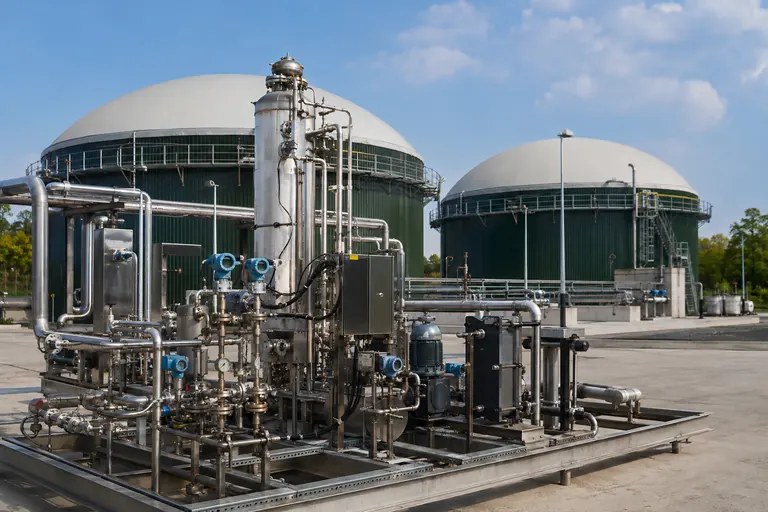
The engineering context
What the assignment needs to resolve
Engineering problems often arise at package boundaries: a pump vendor assumes one slurry condition, the process designer assumes another, and the civil drawing fixes an installation level that neither has checked. Project Engineering Advisory provides a documented review of these interfaces before procurement and construction make them expensive to change.
The review follows the plant as a connected process. Feed preparation, digestion, gas handling, digestate, electrical supply and automation each have their own design basis, but their capacities and operating schedules must agree. Advisory review complements the responsible designer and statutory authorities; it does not replace their approvals or transfer every vendor obligation to one reviewer.
Interfaces that need a named owner
| Interface | Typical mismatch | Review evidence |
|---|---|---|
| Process and civil | Gross tank volume used as working volume | Levels, freeboard, settled solids allowance and piping elevations |
| Pump and piping | Rated flow stated without system head or slurry properties | Pump curve, pipe losses, suction conditions and material basis |
| Upgrader and storage | Hourly capacity calculated for a different shift pattern | Daily gas balance and hourly production/consumption profile |
| Mechanical and electrical | Connected load treated as continuous demand | Motor list, starts, operating schedule and transformer study |
| Controls and operations | Interlocks described but no cause-and-effect ownership | Instrument list, alarms, trips, permissives and test records |
Altpreneur scope
How we approach the work
Design basis review
Reconcile feedstock tests, slurry balance, organic loading, working volume, operating hours and performance assumptions. Identify missing inputs and unproven guarantees.
Equipment and interface review
Check process duties, materials, maintenance access, equipment redundancy and controls. Review how vendor packages connect with foundations, power, piping and instrumentation.
Technical procurement
Prepare or review technical specifications, compare vendor deviations and establish inspection requirements. Separate performance commitments from catalogue descriptions.
Execution support
Track design decisions, technical clarifications and readiness for installation and commissioning. Review handover documentation and agreed performance-test conditions.
Decisions worth getting right
Freeze a common design basis
Track revisions to feedstock, flow, solids, temperature and gas quality. When one basis changes, identify the equipment, drawings and commercial guarantees affected.
Review maintainability before layout approval
Check lifting space, replacement routes, isolation, sampling points and safe access. Equipment that fits in a drawing may still be impossible to service efficiently.
Close comments with evidence
A review comment is closed against a revised drawing, calculation or test record. A meeting discussion without a controlled revision leaves ambiguity for the site team.
Assignment outputs
What you receive
- Design review and action register
- Technical specifications and bid comparisons
- Interface and responsibility matrix
- Inspection and commissioning review comments
- Document and decision tracking
To begin
Useful starting information
- Available process drawings and mass balance
- Vendor offers and equipment specifications
- Project schedule, scope boundaries and performance objectives
Scope and responsibility
Advisory review does not transfer a designer's statutory responsibility or replace a vendor's detailed design unless the contract expressly assigns that responsibility.
Common questions
Can you review another EPC contractor's proposal?
Yes. The review can focus on design adequacy, scope gaps, interfaces, commercial assumptions and the test basis for guaranteed performance.
Can this start during construction?
Yes, but late changes may affect cost and schedule. The review should first identify items that can still be corrected safely.
Evidence & further reading
Source material
- US EPA AgSTAR: Project Development Handbook
- US EPA AgSTAR: Anaerobic Digester/Biogas System Operator Guidebook
Technical references inform the discussion. Final design, operating limits and policy eligibility depend on the project and applicable current documents.